
Long Beach Stands Alone in Canceling Celebration
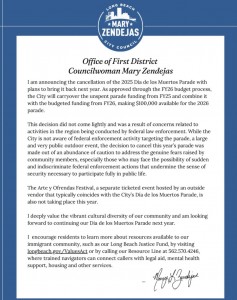
DHS insists there were no plans to raid, but city remains the only U.S. community to cancel its parade.
By Stephen Downing
Across the United States, Día de los Muertos festivals and parades remain on the calendar. In San Antonio, Muertos Fest is set to fill Hemisfair Park with music, altars, and processions. El Paso is moving forward with a mile-long parade. Oakland, Los Angeles, Oceanside, and dozens of other cities from Chicago to Seattle are finalizing plans for events that highlight Mexican heritage, honor ancestors, and draw families into the streets.
As of Sept. 19, Long Beach is the only U.S. city confirmed to have canceled its Día de los Muertos parade over immigration-enforcement concerns. City officials announced earlier this month that the annual parade and the associated Arte y Ofrendas Festival would not take place in 2025. Councilwoman Mary Zendejas explained that the decision was made “out of an abundance of caution,” citing community fears of potential federal immigration actions at large public gatherings.
The cancellation comes with a financial footnote: the city plans to carry over the unspent parade funding from FY25 and combine it with FY26 budgeted funds, making $100,000 available for the 2026 parade. The Arte y Ofrendas Festival – a separate, ticketed event hosted by an outside vendor – is also not taking place this year.
A Divisive Decision
In a recent Substack opinion column titled “When Fear Wins: Long Beach’s Retreat,” this reporter raised questions about whether the city had abandoned its responsibility to stand firmly with its residents. The piece was widely shared on local social media, drawing more than 800 views and provoking a wave of strong support as well as criticism.
One commenter responded: “Obviously you care more for illegals than you care for legal American citizens. Shredding rights? Hardly! Why should anyone who is a legal citizen, and can prove it, be afraid of ICE?”
Another – a city official on the police oversight commission – dismissed the opinion as “high and mighty,” pointing to an old Yiddish saying: “It’s easy to receive a blow on the other guy’s ass.”
Others accused this reporter of overreach: “Are you trying to guilt trip people into your way of thinking?”
The sharp reaction underscores how divisive the issue has become in Long Beach. While critics argue that ICE poses no threat to lawful citizens, immigrant advocates contend that the risk of intimidation or enforcement at cultural events is real and damaging to community trust.
DHS Responds
When asked by the Beachcomber whether DHS had planned any enforcement activity around the Long Beach celebration, Assistant Secretary Tricia McLaughlin issued the following statement:
“Under Secretary Noem, our brave law enforcement officers are delivering on President Trump’s and the American people’s mandate to arrest and deport criminal illegal aliens to make America safe. Those who are not here illegally and are not breaking other laws have nothing to fear. Elected officials choosing to fearmonger by distorting reality are doing a great disservice to our country and are responsible for the nearly 1,000% increase in assaults on ICE officers.”
That DHS framing – pointing to a “1,000% increase” in assaults on ICE officers – has appeared repeatedly in recent department press releases.
Everywhere Else, the Celebrations Continue
Meanwhile, across the country, Día de los Muertos festivities are moving foreward.
- San Antonio’s Muertos Fest returns to Hemisfair Park on Oct. 25–26.
- El Paso will host its annual mile-long parade on Nov. 1.
- Los Angeles is preparing both its Grand Park altar installations (Oct. 25–Nov. 2) and the traditional Olvera Street festival.
- Oakland’s Fruitvale festival is set for Nov. 2.
- Oceanside celebrates on Oct. 26.
- Dallas will stage its late October parade.
- Albuquerque hosts events in both Old Town and the South Valley.
- Mesa, Ariz., will mark the occasion Oct. 25–26.
- Nashville’s Cheekwood Estate holds its festival on November 1–2.
Even smaller cities – like Norcross, Ga. (Nov. 1) and Beaumont, Calif. (Nov. 1) – are proceeding with their own programs.
That contrast leaves Long Beach in a solitary position – a city whose leaders canceled a major cultural event while dozens of others pressed forward. Whether the decision reflects prudent caution or a retreat in the face of fear remains a matter of fierce debate.
Broader Implications – In Carlos’ Words
Carlos Ovalle, a former Long Beach council candidate and longtime community activist, sees the cancellation through a deeply personal lens. A political refugee from Guatemala, Ovalle arrived in Long Beach at age nine after his family fled violent persecution. His father, a government technician, survived two assassination attempts before American friends helped the family escape.
Ovalle says his family’s survival shaped his understanding of governance and democracy:
“I know what it means to live under fear, and I know what it means to stand up to it. That’s why this decision by our city is so painful. Día de los Muertos isn’t just a parade – it’s our heritage, our resilience, our way of affirming life in the face of death. By canceling, Long Beach told its immigrant community that fear rules the day.”
Ovalle believes the city sets a dangerous precedent:
“Every other city in America found a way to protect its people and celebrate its culture. Long Beach stood alone in surrender. Leaders are supposed to stand with their residents, not retreat from them. If we give up our traditions every time fear is at the door, then fear has already won.”
Stephen Downing is a resident of Long Beach and a retired LAPD deputy chief of police.
Editor’s Note: Some social media posts have claimed that other Día de los Muertos celebrations – in Massachusetts, North Carolina, Sacramento, Savannah, or elsewhere – have also been canceled for similar reasons. As of Sept. 19, 2025, the only confirmed cancellation of a Día de los Muertos parade due to immigration-enforcement concerns is in Long Beach. A Hispanic Heritage Month festival in Everett, Mass. was canceled for similar reasons, but it was not a Día de los Muertos event. Long Beach remains the only city we could verify canceling its Día de los Muertos parade due to immigration-enforcement concerns.
Category:
- Log in to post comments
Featured Video

Beachcomber
Copyright 2026 Beeler & Associates.
All rights reserved. Contents may not be reproduced or transmitted – by any means – without publisher's written permission.

